


Inter-Layer Bond Strength Failure after Hydrolysis in PU–Rubber Sole Boots: Best Manufacturing Practices for High Performance Footwear
Understanding The Bonding Mechanism
The durability of the bond between a polyurethane (PU) midsole and a rubber outsole is one of the most critical quality attributes of high-performance footwear such as safety shoes, snow boots, military boots, and industrial footwear. While the initial bond strength may be satisfactory, some manufacturers encounter failures after hydrolysis ageing, where the bond deteriorates following prolonged exposure to heat and moisture. Such failures not only affect product performance but also reduce customer confidence and increase warranty claims.
It is a common misconception that all post-hydrolysis bond failures originate from degradation of the PU material. In fact, where a polyether-based PU system is used, the PU itself generally exhibits excellent resistance to hydrolysis. The more likely causes lie at the interfaces between the PU, reinforcement layer (if used), and rubber outsole, together with the manufacturing process.
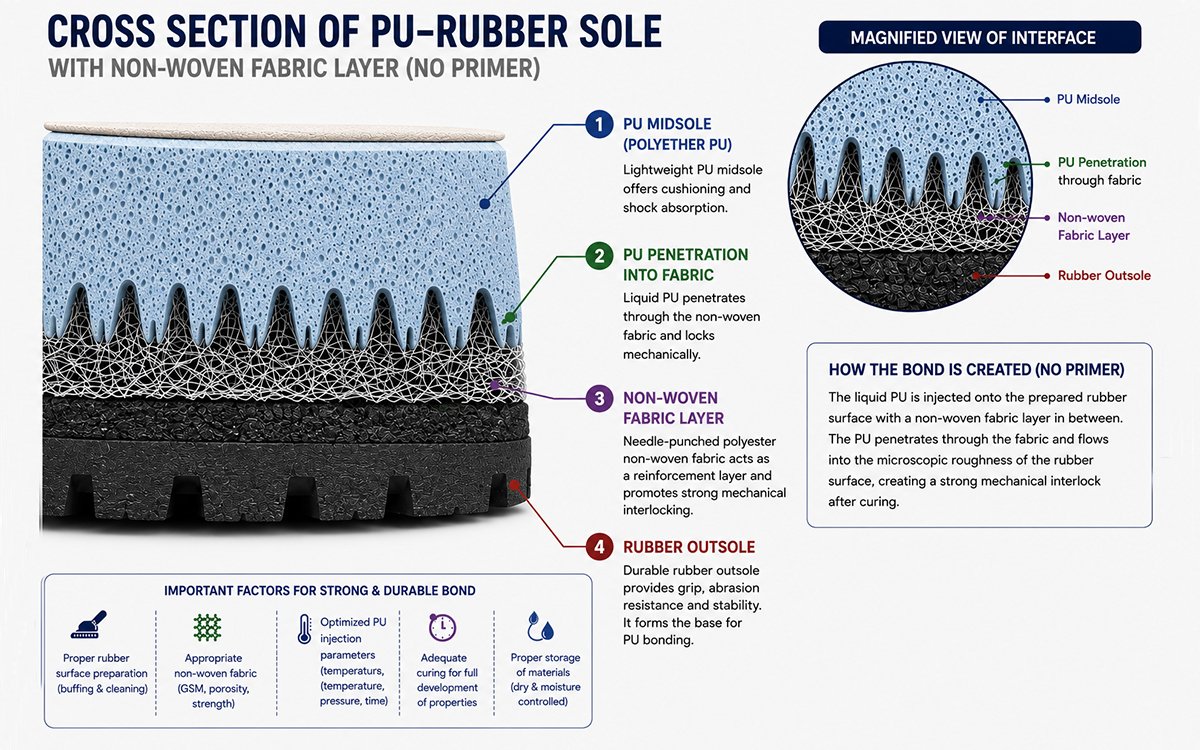
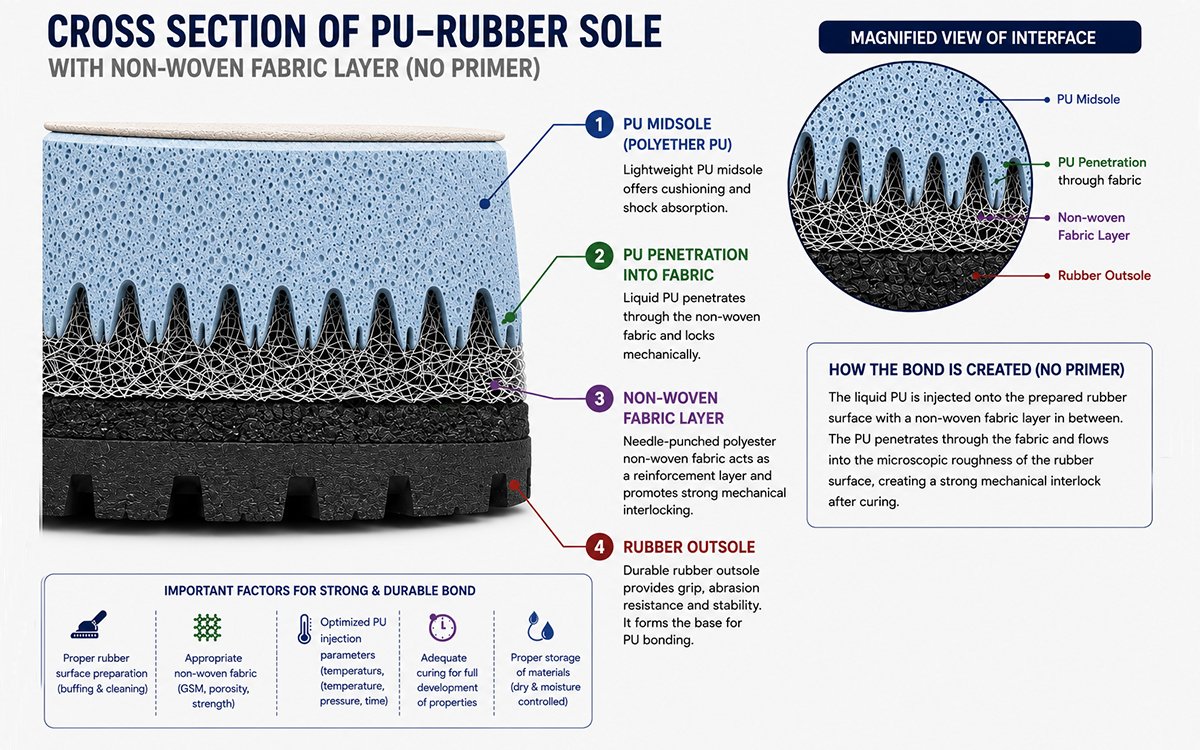
In many direct-moulded PU–rubber sole constructions, a non-woven reinforcement fabric is incorporated between the rubber outsole and the injected PU midsole. This reinforcement improves mechanical anchorage only when the liquid PU adequately penetrates the porous structure of the fabric and forms a strong mechanical lock with the prepared rubber surface. If the PU fails to impregnate the non-woven completely, or if the rubber surface has not been properly prepared, the interface becomes vulnerable to moisture ingress and degradation during hydrolysis.
Best Manufacturing Practices
The quality of the rubber surface preparation is therefore one of the most important factors influencing long-term bond durability. Buffing should produce a fresh, clean surface free from mould release agents, dust, oils, or oxidation. Appropriate cleaning and the use of a compatible rubber primer or adhesion promoter are equally important. Even the best PU system cannot compensate for inadequate surface preparation.
The selection of the non-woven reinforcement also deserves careful attention. Needle-punched polyester non-woven fabrics with suitable porosity generally provide superior PU penetration compared with highly compressed or thermally bonded fabrics. Excessively dense fabrics may act as a barrier, preventing proper mechanical interlocking between the PU and the rubber substrate. Manufacturers should therefore evaluate the fibre composition, GSM, thickness, and permeability of the reinforcement layer as part of their product development process.
Process control during direct moulding is another key determinant of bond performance. Parameters such as mould temperature, PU temperature, moulding pressure, shot size, filling time, and curing conditions directly influence the ability of the PU to wet and penetrate the reinforcement layer. Inadequate curing before hydrolysis testing may also result in lower retained bond strength. Maintaining consistent process parameters and validating them through routine quality checks is essential for reliable production.
When bond failure occurs after hydrolysis, the first step should not be to change the PU formulation. Instead, the manufacturer should determine the actual mode of failure. A simple examination of the fracture surface can establish whether failure has occurred at the PU-to-fabric interface, the fabric-to-rubber interface, within the reinforcement itself, or within the rubber compound. This information provides valuable direction for corrective actions and prevents unnecessary changes to otherwise satisfactory materials.
Conclusion
To improve long-term hydrolysis performance, manufacturers should adopt a systematic approach that includes optimized rubber surface preparation, appropriate primer selection, suitable non-woven reinforcement, controlled PU moulding parameters, and rigorous process validation. Cross-sectional examination of the sole construction, together with routine bond strength testing before and after hydrolysis ageing, should form part of the product qualification programme.
Hydrolysis-resistant footwear is not achieved through a single material or chemical; rather, it is the result of an integrated manufacturing process in which materials, design, surface preparation, and processing work together to produce a durable interface. By focusing on these fundamentals, manufacturers can significantly improve the long-term performance of PU–rubber sole footwear and consistently meet the demanding requirements of military, industrial, and cold-weather applications.
 Category :
Manufacturing and Technology,
Category :
Manufacturing and Technology,

Quick Poll
What do you believe is the most critical factor affecting the long-term durability of PU–Rubber sole bonding after hydrolysis?

About: Prem Mehani
Prem Mehani is a footwear industry professional with extensive experience in footwear materials, testing, quality standards, and safety footwear. He regularly writes on footwear technology, standards, and consumer awareness.

Ask the Expert
Your email address will not be published.